- Reading time: 3 minutes
- Price: Free download
- Published: 2nd November 2021
- Word count: 720 words
- File format: Text
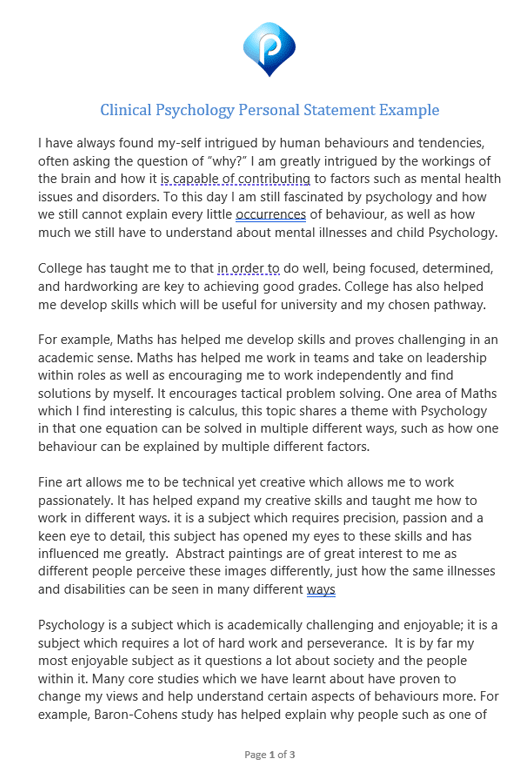
I have always found my-self intrigued by human behaviours and tendencies, often asking the question of “why?” I am greatly intrigued by the workings of the brain and how it is capable of contributing to factors such as mental health issues and disorders. To this day I am still fascinated by psychology and how we still cannot explain every little occurrences of behaviour, as well as how much we still have to understand about mental illnesses and child Psychology.
College has taught me to that in order to do well, being focused, determined, and hardworking are key to achieving good grades. College has also helped me develop skills which will be useful for university and my chosen pathway.
For example, Maths has helped me develop skills and proves challenging in an academic sense. Maths has helped me work in teams and take on leadership within roles as well as encouraging me to work independently and find solutions by myself. It encourages tactical problem solving. One area of Maths which I find interesting is calculus, this topic shares a theme with Psychology in that one equation can be solved in multiple different ways, such as how one behaviour can be explained by multiple different factors.
Fine art allows me to be technical yet creative which allows me to work passionately. It has helped expand my creative skills and taught me how to work in different ways. it is a subject which requires precision, passion and a keen eye to detail, this subject has opened my eyes to these skills and has influenced me greatly. Abstract paintings are of great interest to me as different people perceive these images differently, just how the same illnesses and disabilities can be seen in many different ways.
Psychology is a subject which is academically challenging and enjoyable; it is a subject which requires a lot of hard work and perseverance. It is by far my most enjoyable subject as it questions a lot about society and the people within it. Many core studies which we have learnt about have proven to change my views and help understand certain aspects of behaviours more. For example, Baron-Cohens study has helped explain why people such as one of my friends who suffers from Asperger’s may struggle in understanding sarcasm within jokes and may not understand when someone shows emotions towards them. Debates in psychology such as the nature nurture debate have been of great interest to me as it sheds light on the fact that nature, being genetics, and things you are born with can affect your behaviour and can cause disorders. However, the nurture side shows that behaviours can develop as we grow due to environmental factors, and things such as taking drugs such as amphetamines and cannabis can have an effect on your mental state. Upon learning about the historical connect on mental health I has further gone and researched as to why the views held were there in the first place, and I believe this has added to my interest in the subject.
In 2014 I won the princess Diana award for my efforts in helping with charity work. I also regularly attend rock climbing at the leisure centre, which I immensely enjoy. These activities help me gain skills such as; confidence, and communication. As well as this, I have learnt to appreciate that we are in a fortunate position to help others. I enjoy watching shows such as ‘the secret life of 4-year olds’ which is a series where children up to the ages of 6 are studied, and their behaviours are analysed and given a reason as to why they behave in such ways. This is of interest to me as it looks at behaviours which you wouldn’t normally analyse and picks them apart, thus helping me gain knowledge into child psychology. During busy times and over the summer, I assist the shop floor at Dr Kruger, a clothes shop, in the town city. This job has enabled me to gain valuable skills in interacting with people which has made me feel more organised as a person. The importance of being punctual and time keeping was another valuable lesson which I learnt.
For this reason, I believe I would thrive as a clinical psychology student going onto becoming a fully qualified clinical psychologist.
Why this example works — strengths and ways to improve
Your interest in psychology is sincere, and the Baron-Cohen paragraph shows real engagement with how theory explains someone you know. Much of the statement, though, relies on generic skill claims, forced subject links and listed activities without reflection. The ending asserts suitability rather than earning it. Deepening the psychology content and cutting general statements would make your motivation far more convincing.
Subject motivation
often asking the question of “why?”
Your curiosity comes through, but the opening stays abstract: intrigue, fascination and unanswered questions without a moment, question or idea that sparked them. The later mentions of mental illness and child psychology hint at direction; naming a specific question you want answered would make your motivation distinctive.
Academic preparation
Baron-Cohens study has helped explain why people such as one of my friends
This is your strongest academic evidence, linking a core study to something you have observed. The nature-nurture discussion is accurate but textbook-level. The claim that you researched historical views of mental health is promising yet unspecified; saying what you read and concluded would show independent preparation.
Evidence and reflection
one equation can be solved in multiple different ways
The calculus and abstract-art parallels feel forced; neither explains how these subjects prepare you for psychology. Reflection elsewhere is mostly generic, such as being focused and hardworking. Fewer claims, each explored with what you noticed and why it matters, would carry more weight than broad statements.
Relevant experience
In 2014 I won the princess Diana award for my efforts in helping
An award for charity work could be valuable, but you give no detail of the work or what it taught you about people. The shop job and television series are reasonable evidence; the job could show observation of behaviour or communication, rather than punctuality alone.
Credibility and voice
I has further gone and researched as to why the views held
Your voice feels genuine, but errors like this, “my-self” and “taught me to that” weaken credibility for an academic course. Phrases such as “greatly intrigued” and “great interest” recur often. Careful proofreading and plainer wording would let your genuine interest read more confidently.
Structure and format
For this reason, I believe I would thrive as a clinical psychology student
Moving through each A-level subject in turn makes the middle feel like a list, and the one-sentence conclusion's “for this reason” does not follow from the preceding paragraph about retail work. Leading with psychology and ending on reflection that ties your evidence together would give clearer coherence.
What you’ve done well
- The Baron-Cohen example connects academic theory to a real person you know, showing understanding rather than recall.
- Your consistent interest in child psychology and mental illness gives the statement a potential focus.
How this draft could improve
- Expand the psychology paragraph with the specific historical research you did, what you found and how it changed your thinking.
- Replace the forced Maths and Fine Art analogies with brief, honest notes on transferable skills, or cut them to free space.
- Proofread for grammar and repetition, and write a conclusion that draws together what your evidence shows.