- Reading time: 3 minutes
- Price: Free download
- Published: 19th July 2023
- Word count: 792 words
- File format: Text
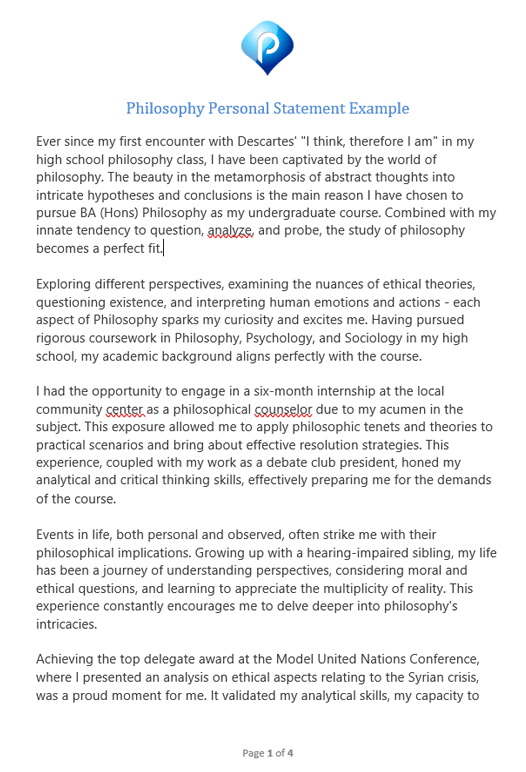
Ever since my first encounter with Descartes’ “I think, therefore I am” in my high school philosophy class, I have been captivated by the world of philosophy. The beauty in the metamorphosis of abstract thoughts into intricate hypotheses and conclusions is the main reason I have chosen to pursue BA (Hons) Philosophy as my undergraduate course. Combined with my innate tendency to question, analyze, and probe, the study of philosophy becomes a perfect fit.
Exploring different perspectives, examining the nuances of ethical theories, questioning existence, and interpreting human emotions and actions – each aspect of Philosophy sparks my curiosity and excites me. Having pursued rigorous coursework in Philosophy, Psychology, and Sociology in my high school, my academic background aligns perfectly with the course.
I had the opportunity to engage in a six-month internship at the local community center as a philosophical counselor due to my acumen in the subject. This exposure allowed me to apply philosophic tenets and theories to practical scenarios and bring about effective resolution strategies. This experience, coupled with my work as a debate club president, honed my analytical and critical thinking skills, effectively preparing me for the demands of the course.
Events in life, both personal and observed, often strike me with their philosophical implications. Growing up with a hearing-impaired sibling, my life has been a journey of understanding perspectives, considering moral and ethical questions, and learning to appreciate the multiplicity of reality. This experience constantly encourages me to delve deeper into philosophy’s intricacies.
Achieving the top delegate award at the Model United Nations Conference, where I presented an analysis on ethical aspects relating to the Syrian crisis, was a proud moment for me. It validated my analytical skills, my capacity to dissect complex issues, and my ability to persuasively communicate my findings and viewpoints.
My critical thinking skills, empathetic understanding, and a knack for effective communication make me a suitable candidate for the BA (Hons) Philosophy course. I can retain a degree of detachment needed to objectively examine philosophic theories and simultaneously empathize with varied viewpoints.
As for my career, I aspire to be a philosopher-counselor or an ethical consultant in a global organization where I can use philosophical insight to tackle practical issues faced by individuals or organizations. By employing an intellectual examination of motives, beliefs, and attitudes, combined with empathy, patience, and communication skills, I hope to stimulate thoughtful discourse and bring about effective solutions.
In my view, philosophy’s relevance extends far beyond classic theories, particularly in today’s context where Artificial Intelligence (AI) isn’t merely a buzzword, but a transformative reality. To understand and contribute effectively to the growing AI debate, I believe it is crucial for one to possess a finely tuned philosophical perspective grounded in ethics, consciousness, and cognition.
Can a machine possess mind or consciousness? Can it intentionally bring harm to humans? We are stepping into an era where these profound philosophical questions have practical implications. My interest extends to probing these questions, attempting to explore if limits exist for machine intelligence in problem-solving. I see my philosophical study as instrumental in equipping me with the necessary intellectual tools to address and navigate these complex contemporary issues where technology intertwines with philosophy.
To ensure machines behave ethically and pose no threat to humans, we need more than just advanced coders – we need philosophical thinkers in AI development teams. These teams need balanced thinkers who can provide perspective not just on the ‘how’ but the ‘why’ and ‘what if’ behind AI. I am excited at the prospect of bringing together my understanding of technology, the intricacies of the human mind, and the moral and ethical principles that guide human behavior to play a role in shaping our AI-driven future.
I plan on incorporating this AI-focused lens as part of my potential future role as a philosopher-counselor or an ethical consultant, keeping my philosophical approach modern and relevant.
This additional layer of Philosophy’s application can be inserted after the paragraph where I discuss my aspirations, thereby providing an insightful connection between my future career plans and the contemporary relevance of philosophy. It further emphasizes my keen awareness of Philosophy’s role in addressing pressing modern-day issues and demonstrates my preparation to utilize my philosophical expertise in a variety of ways.
In essence, philosophy, for me, is a way of life – an astounding exploration of intriguing concepts that go on to color my interactions, my vision of the world, and my approach to challenges. I am eager to delve deeper into its oceanic depth, engage in thoughtful discussions, and bring to light philosophic interpretations that could potentially change perspectives. By selecting me for this course at your esteemed institution, you would be facilitating my ambition to contribute positively to society with a philosophic perspective.
Why this example works — strengths and ways to improve
Your statement shows genuine enthusiasm for philosophy and a promising interest in AI ethics, but it relies heavily on asserted qualities rather than demonstrated thinking. Key experiences are named without detail, the Descartes opening is never explored, and a leftover drafting note about where to insert a paragraph signals the text needs careful revision before it reads as finished.
Subject motivation
Ever since my first encounter with Descartes' "I think, therefore I am"
The Descartes moment could anchor your motivation, but you never say what about the cogito struck you, whether you found it convincing, or what objections occurred to you. Phrases like 'beauty in the metamorphosis of abstract thoughts' describe enthusiasm without showing the philosophical engagement behind it.
Academic preparation
my academic background aligns perfectly with the course
You list Philosophy, Psychology and Sociology but give no texts, topics, essays or arguments you studied. Naming one reading or problem you worked through, and what you concluded, would demonstrate preparation far better than asserting a perfect alignment.
Evidence and reflection
apply philosophic tenets and theories to practical scenarios and bring about effective resolution strategies
This sentence summarises outcomes without showing any. Which theory did you apply, to what kind of situation, and what did it teach you about its limits? The sibling paragraph is similarly promising but abstract; one concrete moment and what it changed in your thinking would be genuine reflection.
Relevant experience
presented an analysis on ethical aspects relating to the Syrian crisis
Debate, Model UN and community-centre work are relevant, yet each is used mainly to claim skills. Briefly explaining the ethical argument you made at Model UN, and why it persuaded, would turn an award into evidence of philosophical reasoning.
Credibility and voice
as a philosophical counselor due to my acumen in the subject
Describing yourself as a counselor with 'acumen' and 'philosophical expertise' at school stage risks sounding overstated. Clarifying what the role actually involved would be more convincing. The AI questions you pose are your most authentic-sounding passage; engaging with one argument there would strengthen your voice.
Structure and format
This additional layer of Philosophy's application can be inserted after the paragraph
This paragraph is a drafting note, not part of the statement, and should be removed. The AI material also feels appended after the conclusion-like career section, and the closing 'esteemed institution' line is formulaic. Reordering so AI links naturally to your aims would improve coherence.
What you’ve done well
- Your AI questions about machine consciousness and intentional harm show a real, contemporary philosophical interest that could become the statement's distinctive thread.
- You draw on varied experiences, including family life with a hearing-impaired sibling, which could offer a personal route into questions of perspective and understanding.
How this draft could improve
- Delete the editorial note about inserting paragraphs and restructure so the AI section connects directly to your career aims before a short conclusion.
- Replace skill claims such as 'honed my analytical and critical thinking skills' with one worked example of an argument you analysed and what you concluded.
- Develop the Descartes opening or an AI question with a specific reading or objection, showing how you actually think philosophically.
Related personal statements
- Theology and Religious Studies BTh Personal Statement Example
- History personal statement example (4)
- History degree personal statement example (3)
- History and Spanish Personal Statement Example
- Linguistics Personal Statement Example
- History and International Relations personal statement
- English literature degree personal statement
- History personal statement example (2)
- English literature personal statement
- Teaching personal statement (chemistry)