- Reading time: 3 minutes
- Price: Free download
- Published: 20th July 2023
- Word count: 668 words
- File format: Text
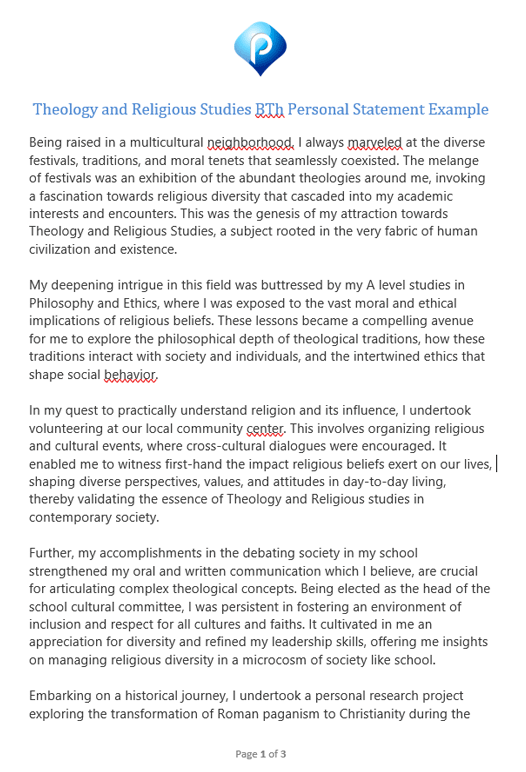
Being raised in a multicultural neighborhood, I always marveled at the diverse festivals, traditions, and moral tenets that seamlessly coexisted. The melange of festivals was an exhibition of the abundant theologies around me, invoking a fascination towards religious diversity that cascaded into my academic interests and encounters. This was the genesis of my attraction towards Theology and Religious Studies, a subject rooted in the very fabric of human civilization and existence.
My deepening intrigue in this field was buttressed by my A level studies in Philosophy and Ethics, where I was exposed to the vast moral and ethical implications of religious beliefs. These lessons became a compelling avenue for me to explore the philosophical depth of theological traditions, how these traditions interact with society and individuals, and the intertwined ethics that shape social behavior.
In my quest to practically understand religion and its influence, I undertook volunteering at our local community center. This involves organizing religious and cultural events, where cross-cultural dialogues were encouraged. It enabled me to witness first-hand the impact religious beliefs exert on our lives, shaping diverse perspectives, values, and attitudes in day-to-day living, thereby validating the essence of Theology and Religious studies in contemporary society.
Further, my accomplishments in the debating society in my school strengthened my oral and written communication which I believe, are crucial for articulating complex theological concepts. Being elected as the head of the school cultural committee, I was persistent in fostering an environment of inclusion and respect for all cultures and faiths. It cultivated in me an appreciation for diversity and refined my leadership skills, offering me insights on managing religious diversity in a microcosm of society like school.
Embarking on a historical journey, I undertook a personal research project exploring the transformation of Roman paganism to Christianity during the reign of Emperor Constantine. This focused study underlined the historical fluidity of religious beliefs and sparked my interest in archaeology and its significance in understanding religious evolution and parallel societal changes. In order to gain a more comprehensive understanding, I attended a short online course in comparative religion, which provided me a sound base in identifying and analyzing the parallels, intersections, and deviations in major world religions.
With proficient skills of critical analysis, argumentation, research, and empathy, I am well-positioned to excel in the undergraduate degree in Theology and Religious Studies. My analytical ability would enable me to dissect intricate ideologies; argumentative skills to provide robust religious defenses, and the continuous yearn for knowledge amplifies my research abilities, while empathy aids in understanding various religious practices from the follower’s perspective.
My vision is to work within the framework of interfaith dialog and conflict resolution, being a voice for religious tolerance and understanding. I see the study of theology, not just as a matter of personal interest, but as an indispensable tool for bridging gaps in religious understanding, resolving conflicts, and constructing a harmonious society. This aspiration extends to my goal of acquiring a role within the United Nations, focusing on peacekeeping and conflict resolution instigated by religious misunderstanding.
To remain aligned with my goals, the BTh Theology & Religious Studies is a clear step forward. The broad scope offered in your program, combined with the possibility to specialize in areas of my interest, such as Interfaith Dialogue or Religious History, aligns perfectly with my ambitions. The cross-disciplinary approach and an environment encouraging intellectual curiosity is excellent for furthering my understanding of this multifaceted discipline.
In conclusion, my fascination for understanding religious diversity, my academic engagements, and the overall experiences profoundly resonate with my ambition to pursue Theology & Religious Studies. Embracing the depth of this course, I look forward to embarking on an enriching journey of religious exploration, contributing to the diversity of the university, and utilizing my gained wisdom in bringing harmony in a diverse world. With a quenchless thirst for understanding the profound mysteries of religion and faith, I am excited to navigate through countless dialogues, debates, and discourses marking my journey in Theology & Religious Studies.
Why this example works — strengths and ways to improve
Your statement has a coherent thread, religious diversity leading toward interfaith work, and promising material: community events, a Constantine project, a comparative religion course. However, it mostly names activities and asserts their value rather than showing what you discovered. Ornate phrasing and self-assessed skills crowd out the specific ideas, sources and reflections that would make your interest convincing.
Subject motivation
I always marveled at the diverse festivals, traditions, and moral tenets
The neighbourhood origin is plausible and personal, but it stays general. Naming one festival, practice or moral tension you actually noticed, and the question it raised, would turn broad fascination into a specific intellectual motive for studying Theology rather than simply appreciating diversity.
Academic preparation
exposed to the vast moral and ethical implications of religious beliefs
A level Philosophy and Ethics is directly relevant, yet you mention no topic, thinker or argument. One debate you engaged with, such as a specific ethical theory applied to religious belief, would show genuine preparation instead of exposure described in abstract terms.
Evidence and reflection
underlined the historical fluidity of religious beliefs
The Constantine project is your strongest academic evidence, but its conclusion is generic. What sources did you use? What surprised you about conversion, syncretism or imperial motives? Reflection here should show a changed understanding, not just a broad lesson any reader could anticipate.
Relevant experience
organizing religious and cultural events, where cross-cultural dialogues were encouraged
Volunteering and the cultural committee are well suited to your interfaith goal. Currently they are summarised, not explored. Describe one dialogue, disagreement or practical challenge and what it taught you about how belief shapes behaviour. That would replace claims like "validating the essence" with real insight.
Credibility and voice
With proficient skills of critical analysis, argumentation, research, and empathy
Self-rated skill lists weaken credibility. So do inflated phrases like "quenchless thirst", "buttressed" and "gained wisdom". Also, "robust religious defenses" sits oddly with a Religious Studies emphasis on critical analysis. A plainer voice with concrete detail would sound more mature and more like you.
Structure and format
In conclusion, my fascination for understanding religious diversity
The sequence is logical, moving from origin through study and activities to career and fit. However, the skills paragraph and the conclusion largely restate earlier points. The tense also slips ("This involves… were encouraged"). Cutting repetition would free space for the reflection your evidence currently lacks.
What you’ve done well
- Your thread from a multicultural upbringing through community work to interfaith dialogue is consistent and gives the statement direction.
- The Constantine research project and the comparative religion course show independent initiative beyond the classroom.
How this draft could improve
- Choose two experiences, such as the Constantine project and one community event, and develop each with specific detail plus what changed in your thinking.
- Replace the self-assessed skills paragraph with evidence that demonstrates those skills, and cut ornate phrases in favour of direct language.
- Make course fit concrete by explaining why interfaith dialogue or religious history interests you intellectually, not only how it serves a UN career.
Related personal statements
- Philosophy BA (Hons) Personal Statement Example
- History personal statement example (4)
- History degree personal statement example (3)
- History and Spanish Personal Statement Example
- Linguistics Personal Statement Example
- History and International Relations personal statement
- English literature degree personal statement
- History personal statement example (2)
- English literature personal statement
- Teaching personal statement (chemistry)