- Reading time: 3 minutes
- Price: Free download
- Published: 6th July 2023
- Word count: 692 words
- File format: Text
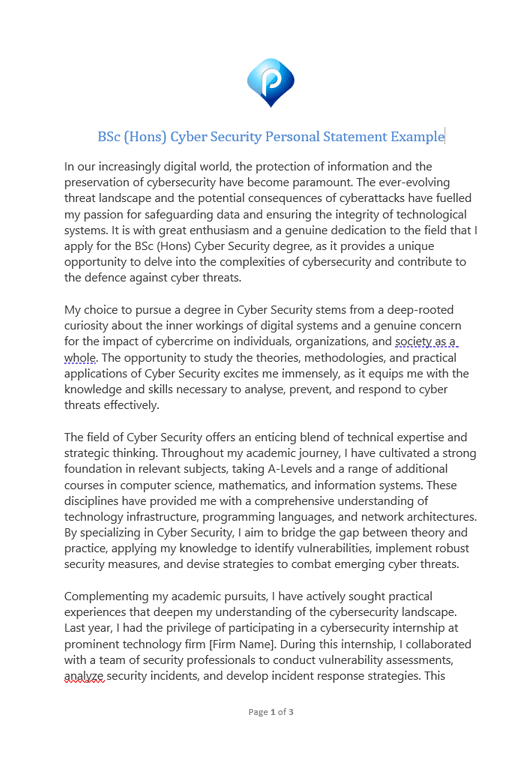
In our increasingly digital world, the protection of information and the preservation of cybersecurity have become paramount. The ever-evolving threat landscape and the potential consequences of cyberattacks have fueled my passion for safeguarding data and ensuring the integrity of technological systems. It is with great enthusiasm and a genuine dedication to the field that I apply for the BSc (Hons) Cyber Security degree, as it provides a unique opportunity to delve into the complexities of cybersecurity and contribute to the defense against cyber threats.
My choice to pursue a degree in Cyber Security stems from a deep-rooted curiosity about the inner workings of digital systems and a genuine concern for the impact of cybercrime on individuals, organizations, and society as a whole. The opportunity to study the theories, methodologies, and practical applications of Cyber Security excites me immensely, as it equips me with the knowledge and skills necessary to analyze, prevent, and respond to cyber threats effectively.
The field of Cyber Security offers an enticing blend of technical expertise and strategic thinking. Throughout my academic journey, I have cultivated a strong foundation in relevant subjects, taking A-Levels and a range of additional courses in computer science, mathematics, and information systems. These disciplines have provided me with a comprehensive understanding of technology infrastructure, programming languages, and network architectures. By specializing in Cyber Security, I aim to bridge the gap between theory and practice, applying my knowledge to identify vulnerabilities, implement robust security measures, and devise strategies to combat emerging cyber threats.
Complementing my academic pursuits, I have actively sought practical experiences that deepen my understanding of the cybersecurity landscape. Last year, I had the privilege of participating in a cybersecurity internship at prominent technology firm [Firm Name]. During this internship, I collaborated with a team of security professionals to conduct vulnerability assessments, analyze security incidents, and develop incident response strategies. This hands-on experience exposed me to the intricacies of cybersecurity operations and the significance of proactive measures in safeguarding critical information. It reinforced my dedication to a career focused on protecting digital assets and ensuring data privacy.
One achievement that I am particularly proud of is my contribution to a university-based cybersecurity competition. As a member of the team, I participated in simulated real-world scenarios, testing our ability to identify and mitigate security vulnerabilities, respond to incidents, and devise effective risk management strategies. This experience not only honed my technical skills but also highlighted the importance of collaboration, adaptability, and critical thinking in the realm of Cyber Security. It solidified my belief that a proactive and multidisciplinary approach is crucial in defending against evolving cyber threats.
In addition to my technical skills, I possess a range of transferable skills that make me well-suited for this degree. I am detail-oriented, with a keen eye for detecting anomalies and patterns that could signify potential security breaches. My strong analytical and problem-solving abilities enable me to dissect complex security challenges and develop effective solutions. Moreover, I am a clear and concise communicator, capable of translating technical jargon into understandable terms, facilitating collaboration between technical and non-technical stakeholders.
Looking ahead, I am excited to contribute to the field of Cyber Security and play a vital role in protecting digital assets. With this degree, I aim to pursue postgraduate studies, focusing on specialized areas such as network security or digital forensics. Ultimately, I aspire to work as a cybersecurity professional, collaborating with organizations to develop robust security strategies, conduct thorough risk assessments, and implement best practices to safeguard sensitive data. I am committed to staying at the forefront of the ever-evolving cybersecurity landscape, continually updating my knowledge and skills to tackle emerging threats and ensure a secure digital environment for individuals and organizations.
In conclusion, my passion for Cyber Security, my academic foundation, practical experiences, and transferable skills make me an ideal candidate for studying this degree at [University]. I am eager to deepen my knowledge in this rapidly evolving field, contribute to cutting-edge research, and apply my skills to protect digital infrastructures from malicious activities. I am dedicated to playing a crucial role in safeguarding the integrity, confidentiality, and availability of information in an increasingly interconnected world.
Why this example works — strengths and ways to improve
This archived statement has potentially strong material, including an internship and a team competition, but abstract, repetitive language obscures it. Motivation and skills are asserted rather than shown through specific moments, tools or problems. The writing rarely explains what you personally did, found difficult or learned, so the reader struggles to picture you as a cyber security student.
Subject motivation
stems from a deep-rooted curiosity about the inner workings of digital systems
You name curiosity and concern about cybercrime but never show where they began. A specific trigger, such as a news breach, a misconfigured home network or a puzzle you tried to solve, would turn this declared interest into believable motivation. The opening sentence about an increasingly digital world could describe any applicant.
Academic preparation
taking A-Levels and a range of additional courses in computer science, mathematics
The subjects are relevant, but no subject, topic or course is identified precisely. Claiming a comprehensive understanding of network architectures is a large claim for this stage. Naming one concept you studied, such as encryption, subnetting or a programming project, and what it taught you would carry more weight.
Evidence and reflection
highlighted the importance of collaboration, adaptability, and critical thinking
Reflection here lists generic qualities that could follow almost any team activity. Strong reflection explains a specific challenge, a decision you made and what changed in your understanding. One vulnerability you identified, or a moment where the team's approach failed, would show genuine learning more clearly.
Relevant experience
conduct vulnerability assessments, analyze security incidents, and develop incident response strategies
The internship and competition are your best evidence, but the duties read like a job description. Clarify your own role, since leading incident response sounds advanced for this stage. Naming the competition, the tools you used or the task you owned would make the experience concrete and credible.
Credibility and voice
I am a clear and concise communicator, capable of translating technical jargon
Self-assessments like this are undercut by prose that is often wordy. Phrases such as 'ever-evolving threat landscape' and 'paramount' sound formulaic rather than personal. Demonstrating clarity, for instance by explaining one technical idea simply, would prove the communication skill you claim.
Structure and format
In conclusion, my passion for Cyber Security, my academic foundation, practical experiences
The ordering is logical, but the opening, skills and closing paragraphs repeat the same ideas about protecting digital assets. The conclusion summarises the statement rather than adding anything new. Its reference to research also gives no reason for choosing this particular course or institution.
What you’ve done well
- You include genuinely relevant practical evidence, an internship and a team competition, that many applicants lack.
- Your closing reference to confidentiality, integrity and availability shows awareness of core security principles, and your interest in network security and digital forensics points to a clear direction.
How this draft could improve
- Replace general claims with one or two detailed episodes from the internship or competition, stating your specific task, the tools you used, a problem you faced and what you learned.
- Cut repeated phrases about the evolving threat landscape and protecting digital assets, and use the space to show one concrete academic topic or independent project.
- Make the stated fit specific by naming course features you want, or remove the generic claim about research.
Related personal statements
- Web Design & Development BSc (Hons) Personal Statement Example
- Games Design and Development BSc (Hons) Personal Statement
- Computer Science Personal Statement (8)
- Computer Science Personal Statement Example (7)
- Computer Science Masters Personal Statement Example
- Computer Science MS Degree Personal Statement Example
- Computer Science personal statement example (6)
- Computer Science Personal Statement Example (5)
- Managing Information Technology Masters Degree personal statement
- Artificial Intelligence Masters Degree Personal Statement Example