- Reading time: 3 minutes
- Price: Free download
- Published: 18th January 2023
- Word count: 661 words
- File format: Text
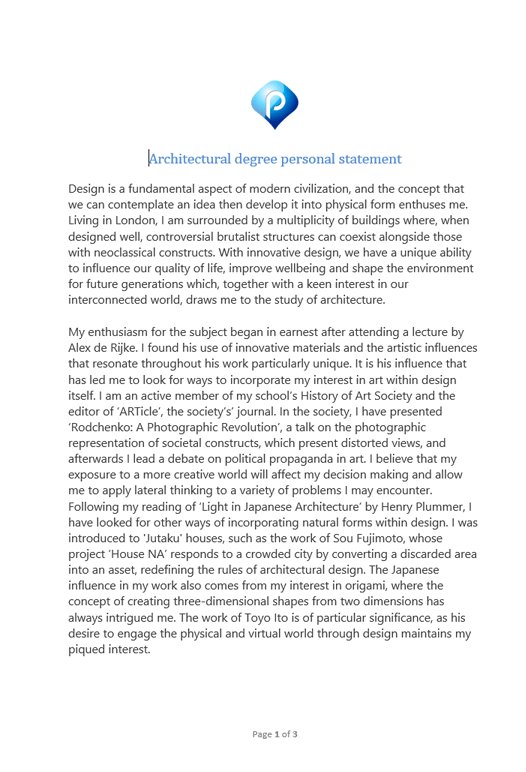
Design is a fundamental aspect of modern civilization, and the concept that we can contemplate an idea then develop it into physical form enthuses me. Living in London, I am surrounded by a multiplicity of buildings where, when designed well, controversial brutalist structures can coexist alongside those with neoclassical constructs. With innovative design, we have a unique ability to influence our quality of life, improve wellbeing and shape the environment for future generations which, together with a keen interest in our interconnected world, draws me to the study of architecture.
My enthusiasm for the subject began in earnest after attending a lecture by Alex de Rijke. I found his use of innovative materials and the artistic influences that resonate throughout his work particularly unique. It is his influence that has led me to look for ways to incorporate my interest in art within design itself. I am an active member of my school’s History of Art Society and the editor of ‘ARTicle’, the society’s’ journal. In the society, I have presented ‘Rodchenko: A Photographic Revolution’, a talk on the photographic representation of societal constructs, which present distorted views, and afterwards I lead a debate on political propaganda in art. I believe that my exposure to a more creative world will affect my decision making and allow me to apply lateral thinking to a variety of problems I may encounter. Following my reading of ‘Light in Japanese Architecture’ by Henry Plummer, I have looked for other ways of incorporating natural forms within design. I was introduced to ‘Jutaku’ houses, such as the work of Sou Fujimoto, whose project ‘House NA’ responds to a crowded city by converting a discarded area into an asset, redefining the rules of architectural design. The Japanese influence in my work also comes from my interest in origami, where the concept of creating three-dimensional shapes from two dimensions has always intrigued me. The work of Toyo Ito is of particular significance, as his desire to engage the physical and virtual world through design maintains my piqued interest.
To add a practical element to my interest, for my Design Technology project I am designing a pavilion for the Art Department at my school. Incorporating structural origami designs, I hope to create a multifunctional, modular space, which respects the surrounding environment and can be continually adapted to cater for my clients’ ever-changing spatial needs. I have also been fortunate to undertake a placement at TP Bennett, which allowed me to comprehend the complexities of the profession. The understanding I gained working with interior designers, architects, engineers, and a site visit provided valuable practical experience, reinforcing my preconceptions of an architectural career with reality. Next year, after being invited to return, I hope to develop my knowledge further and learn more about the industry. I also have an intensive job as a barista at a local independent café, which has given me useful skills in dealing with customers and I have also recently submitted plans to my management for a vandal-proof park cafe and wish to be involved in concepts for the upcoming project.
Mathematics has always been relevant to me, I find the parameters and accuracy of the work satisfying, but also enjoy the opportunity to solve problems in a more abstract way. My geography course highlights current environmental issues such as rapid population growth and the scarcity of space and resources, which continually prompt me to be perceptive of our environment. I am also inspired to use design to tackle immediate issues such as overpopulation and global warming as, for me, there is an imminent need to modify architectural processes to provide a more sustainable environment. The constant reinvention and imagination of the field continues to excite me, and in embarking on an Architectural degree I hope to gain invaluable skills in sophisticated design where I could positively contribute to the world in a physical and permanent sense.
2017-12-19-1513645416
Originally published 15.10.2019 on a sister site.
Why this example works — strengths and ways to improve
This statement shows genuine, well-sourced curiosity about architecture, especially Japanese design and material innovation, and offers promising practical evidence through the pavilion project, placement and café proposal. Its main weakness is that reflection often stops at naming influences or asserting benefits. Deeper explanation of what you designed, decided or learned would make the strongest evidence persuasive rather than descriptive.
Subject motivation
the concept that we can contemplate an idea then develop it into physical form enthuses me
Your motivation is sincere but begins broadly, with claims about civilisation and wellbeing that many applicants could write. The London brutalist-neoclassical observation is more personal, yet you do not name a building or explain what 'designed well' means. A concrete example would make the attraction distinctively yours.
Academic preparation
Following my reading of ‘Light in Japanese Architecture’ by Henry Plummer
Reading Plummer and studying Fujimoto and Ito shows real independent engagement. However, you summarise these works rather than analysing them. What did Plummer change in how you see light? The mathematics and geography paragraph is thin, relying on general enjoyment instead of a specific problem, topic or method.
Evidence and reflection
reinforcing my preconceptions of an architectural career with reality
This placement sentence gestures at reflection without stating which preconceptions changed or what complexities you met. Similarly, the claim that creative exposure will 'allow me to apply lateral thinking' is a generic skill claim. Naming one observed decision or tension would turn assertion into insight.
Relevant experience
I have also recently submitted plans to my management for a vandal-proof park cafe
This is excellent ordinary evidence: you identified a real design brief from your job and acted on it. It deserves more space than the customer-skills line before it. Explain how you approached vandal-proofing, materials or user flow. The origami pavilion would benefit from the same treatment.
Credibility and voice
redefining the rules of architectural design
Phrases like this, 'particularly unique' and 'maintains my piqued interest' feel inflated and slightly borrowed, weakening an otherwise authentic voice. Your credible voice emerges in the Rodchenko talk and café plans. Let plain, precise description carry authority rather than superlatives.
Structure and format
Mathematics has always been relevant to me
The middle paragraphs are logically grouped, but the long second paragraph moves from art society to Plummer to origami to Ito without clear links. Academic subjects arrive late and feel appended. Minor errors such as 'society’s’' and 'I lead' for 'led' need correcting.
What you’ve done well
- A coherent interest in Japanese architecture connects reading, named architects, origami and your own pavilion design.
- The barista job is used imaginatively, producing an unprompted design proposal that shows initiative beyond the placement.
How this draft could improve
- Choose two pieces of evidence, such as the pavilion and café plans, and explain specific design decisions and what you learned from them.
- Replace generic claims about lateral thinking and wellbeing with one analysed building or idea from your reading.
- Tighten the second paragraph, cut superlatives, and fix the grammatical slips.
Related personal statements
- Jewellery and objects BA (Hons) personal statement example
- Renewable Energy Systems MEng Personal Statement Example
- Urban Planning BSc (Hons) Personal Statement Example
- Aerospace Engineering BEng Personal Statement Example
- Aeronautical / Astronautical Engineering Personal Statement
- Civil engineering personal statement example
- Mechanical Engineer Personal Statement Example Personal Statement
- Engineering Personal Statement Examples
- Engineering degree personal statement example
- Construction Management Masters personal statement