- Reading time: 4 minutes
- Price: Free download
- Published: 21st July 2022
- Word count: 953 words
- File format: Text
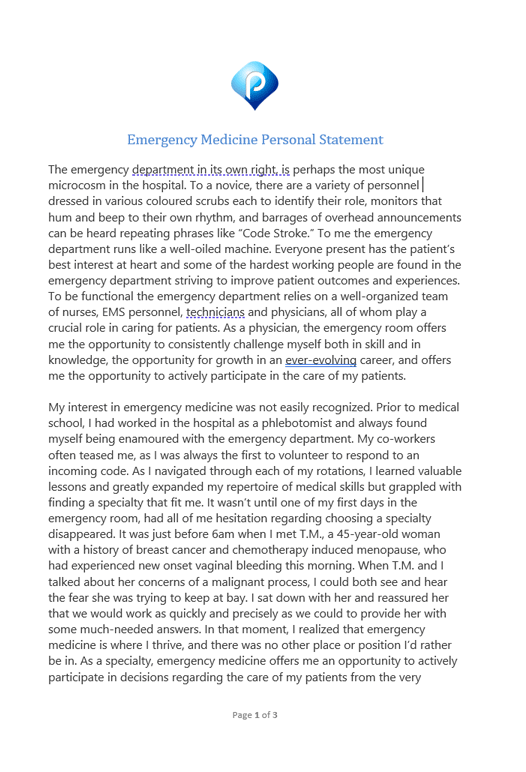
The emergency department in its own right, is perhaps the most unique microcosm in the hospital. To a novice, there are a variety of personnel dressed in various colored scrubs each to identify their role, monitors that hum and beep to their own rhythm, and barrages of overhead announcements can be heard repeating phrases like “Code Stroke.” To me the emergency department runs like a well oiled machine. Everyone present has the patient’s best interest at heart and some of the hardest working people are found in the emergency department striving to improve patient outcomes and experiences. To be functional the emergency department relies on a well organized team of nurses, EMS personnel, technicians and physicians, all of whom play a crucial role in caring for patients. As a physician, the emergency room offers me the opportunity to consistently challenge myself both in skill and in knowledge, the opportunity for growth in an ever evolving career, and offers me the opportunity to actively participate in the care of my patients.
My interest in emergency medicine was not easily recognized. Prior to medical school, I had worked in the hospital as a phlebotomist and always found myself being enamored with the emergency department. My co-workers often teased me, as I was always the first to volunteer to respond to an incoming code. As I navigated through each of my rotations, I learned valuable lessons and greatly expanded my repertoire of medical skills, but grappled with finding a specialty that fit me. It wasn’t until one of my first days in the emergency room, had all of me hesitation regarding choosing a specialty disappeared. It was just before 6am when I met T.M., a 45 year old woman with a history of breast cancer and chemotherapy induced menopause, who had experienced new onset vaginal bleeding this morning. When T.M. and I talked about her concerns of a malignant process, I could both see and hear the fear she was trying to keep at bay. I sat down with her and reassured her that we would work as quickly and precisely as we could to provide her with some much needed answers. In that moment, I realized that emergency medicine is where I thrive, and there was no other place or position I’d rather be in. As a specialty, emergency medicine offers me an opportunity to actively participate in decisions regarding the care of my patients from the very beginning while also allowing me the satisfaction of being present in their most vulnerable moments.
My passion and personal goal of providing excellent healthcare to each patient, regardless of their ability to pay for health insurance, is also matched in the emergency department. The emergency room triages patients based solely on their clinical presentation, giving each individual equal access to care. As a physician, I seek to provide the highest level of care for all types of individuals, as I firmly believe access to healthcare services are a basic human right. The philosophies of the emergency department are congruent with my own. Not everyone has access to consistent health care, and the emergency room serves as a safe net for those who are unable to afford health insurance. While in medical school in St. Maarten, I encountered dozens of patients who did not have access to primary care and relied on the emergency medicine for long overdue interventions. Each of these cases offered me an opportunity to educate and counsel patients on the need for consistent care, the importance of follow up, the negative effects of smoking or drinking, and any symptoms or signs that could signify a worsening condition.
My hunger for knowledge, desire to be procedurally proficient and determination to solve complicated puzzles additionally supports my desire be an emergency medicine physician. As I learned throughout my clinical experiences, textbook presentations rarely occur, and the most common diagnoses can present in a myriad of ways. In the emergency department, we had a patient who had come in with the complaint of chest pain and generalized weakness; vitals were stable as was his EKG. As I began to take his history it was obvious he had an extensive cardiac history, but as our conversation continued, he oscillated in and out of consciousness as though he was sleeping. No one seemed concerned, but I pushed for the attending to see him immediately, and stated that I was concerned for the possibility of a stroke. Within what seemed like seconds, I had placed the IV, we were pushing the gurney down the hall towards CT and notification calling out the “Code Stroke” could be heard. The neurologist informed us that the patient had experienced a left MCA stroke and if we had waited any longer the prognosis would have been poor and both attendings thanked me for my persistence with the case.
I have chosen a career in Emergency Medicine, because I greatly enjoy its unpredictability and diagnostic approach to medicine. My goal is to join a residency program that emphasizes community medicine and care for the underserved population. I seek the opportunity to work for a program that will provide academic rigor and diverse patient care experiences that will allow me to develop into a confident and proficient Emergency Medicine physician. I have come to appreciate the wide breadth of this field and look forward to further exploring all its facets in your residency program. I will bring extreme dedication, passion and a willingness to continually improve and expand on my knowledge and clinical skills. I look forward to continuing my career journey by being selected to join a residency program that will allow me to become a competent, versatile and compassionate doctor.
Why this example works — strengths and ways to improve
This residency statement has real clinical material, especially the stroke case and your phlebotomy background, but it leans on general claims about the emergency department and ends with interchangeable residency language. The strongest moments show judgement and advocacy. Deeper reflection on what you learned, tighter editing and less generic framing would make your motivation more distinctive and convincing.
Subject motivation
I was always the first to volunteer to respond to an incoming code
This detail gives your interest a believable history before medical school. However, the T.M. encounter is presented as an instant revelation without explaining what in that moment differed from other rotations. Saying what specifically clicked, beyond reassurance, would make the turning point persuasive rather than asserted.
Academic preparation
textbook presentations rarely occur, and the most common diagnoses can present in a myriad of ways
You signal awareness of diagnostic complexity, which suits emergency medicine, but this is a widely shared observation. The stroke case would support it better if you briefly named the clinical reasoning that made you suspect stroke despite stable vitals and EKG, showing your preparation rather than stating it.
Evidence and reflection
No one seemed concerned, but I pushed for the attending to see him immediately
This is your most compelling evidence: initiative, concern and escalation under uncertainty. The paragraph ends on the attendings' thanks rather than your reflection. Consider what the case taught you about trusting observations or communicating concern within a team; that insight matters more than the praise.
Relevant experience
I encountered dozens of patients who did not have access to primary care
The St. Maarten experience connects well to your stated interest in underserved care, a genuine thread. Yet it is summarised as a list of counselling topics. One concrete patient interaction, briefly described, would demonstrate this commitment far better than the general account.
Credibility and voice
Within what seemed like seconds, I had placed the IV
Your voice is sincere, but phrases like 'most unique microcosm', 'extreme dedication' and 'well oiled machine' feel generic. In the stroke story, your role sounds slightly central; acknowledging the team's contribution would strengthen credibility. Errors such as 'all of me hesitation' and 'safe net' undermine polish.
Structure and format
offers me the opportunity to consistently challenge myself both in skill and in knowledge
The overall arc is logical, but the opening spends a paragraph describing the department rather than you, and 'opportunity' repeats three times in one sentence. The conclusion restates goals generically and never names what you seek in a specific programme, weakening the ending.
What you’ve done well
- The stroke case shows clinical alertness and willingness to advocate for a patient, directly relevant to emergency medicine.
- Your phlebotomy work and St. Maarten experience create a coherent thread linking long-standing interest with care for underserved patients.
How this draft could improve
- Replace the descriptive opening with a sentence grounded in your own experience, and cut generic phrases about the department.
- After each case, add one or two sentences reflecting on what you learned and how it changed your practice.
- Proofread carefully for grammatical errors and repetition, and make the conclusion specific about the residency features you value.
Related personal statements
- Mental Health Nursing BSc personal statement example
- Sports and Exercise Science BSc
- Sport Science BSc (Hons) personal statement
- Medicine personal statement example (9)
- Medicine (Undergraduate) Personal Statement Example (8)
- Physiatry (Residency Program) Personal Statement Example
- Veterinary School Personal Statement Example
- Nursing Science and Healthcare Leadership MSc personal statement example
- Occupational therapy personal statement example
- Medicine example personal statement (7)