- Reading time: 3 minutes
- Price: Free download
- Published: 22nd November 2021
- Word count: 730 words
- File format: Text
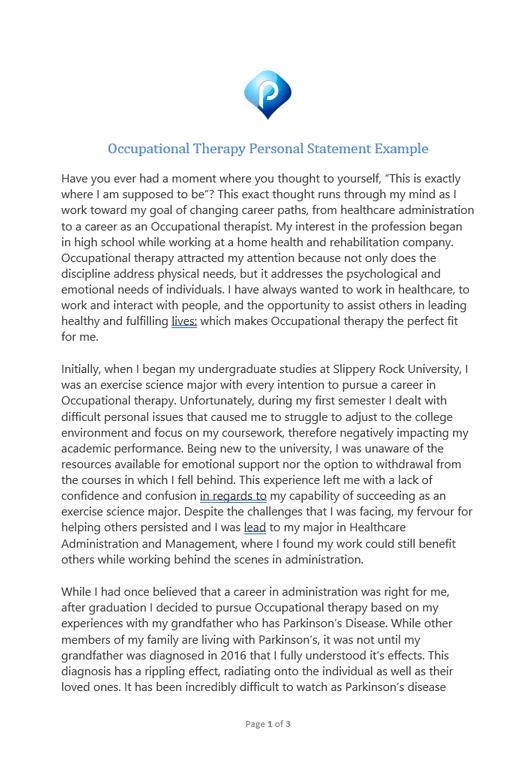
Have you ever had a moment where you thought to yourself, “This is exactly where I am supposed to be”? This exact thought runs through my mind as I work toward my goal of changing career paths, from healthcare administration to a career as an Occupational therapist. My interest in the profession began in high school while working at a home health and rehabilitation company. Occupational therapy attracted my attention because not only does the discipline address physical needs, but it addresses the psychological and emotional needs of individuals. I have always wanted to work in healthcare, to work and interact with people, and the opportunity to assist others in leading healthy and fulfilling lives; which makes Occupational therapy the perfect fit for me.
Initially, when I began my undergraduate studies at Slippery Rock University, I was an exercise science major with every intention to pursue a career in Occupational therapy. Unfortunately, during my first semester I dealt with difficult personal issues that caused me to struggle to adjust to the college environment and focus on my coursework, therefore negatively impacting my academic performance. Being new to the university, I was unaware of the resources available for emotional support nor the option to withdrawal from the courses in which I fell behind. This experience left me with a lack of confidence and confusion in regards to my capability of succeeding as an exercise science major. Despite the challenges that I was facing, my fervor for helping others persisted and I was lead to my major in Healthcare Administration and Management, where I found my work could still benefit others while working behind the scenes in administration.
While I had once believed that a career in administration was right for me, after graduation I decided to pursue Occupational therapy based on my experiences with my grandfather who has Parkinson’s Disease. While other members of my family are living with Parkinson’s, it was not until my grandfather was diagnosed in 2016 that I fully understood it’s effects. This diagnosis has a rippling effect, radiating onto the individual as well as their loved ones. It has been incredibly difficult to watch as Parkinson’s disease attempts to strip my grandfather of his self-reliance and ability to do the things that give him fulfillment. Occupational therapy allows him to hold onto his independence and to remain living safely in his home. His occupational therapists have provided him with intervention such as the special pencil grips that enable him to complete his nightly crossword puzzles, an exercise plan that allows him to maintain his strength, and education on safety in the home and safety during transfers. The positive impact that occupational therapy has on my grandfather’s quality of life is the reason that I have chosen to pursue this path again. I too, want to be someone who enhances and enables others to participate in the everyday activities that give their lives meaning.
I believe that my undergraduate degree in Healthcare Administration and Management is my strength and makes me a unique applicant. My degree provided me with the knowledge in the principles behind healthcare leadership, healthcare quality improvement processes, motivation, teamwork processes, healthcare information systems, the legal and regulatory environment, as well as managed care and healthcare reimbursement. I have had the opportunity to gain insight and experience by working in a variety of settings such as home health, long-term care, and adult day health care. By working in administration, I have seen firsthand how Occupational therapists work cohesively with different departments in order to ensure that patients receive the best quality of care. I have grown professionally through my experiences in healthcare, by developing a strong work ethic along with key skills such as communication, team work, social perceptiveness, problem solving, and organization – all which are skills that I will carry with me into a career in Occupational therapy. I possess knowledge not only in the science and anatomical requirements necessary to pursue a graduate degree in Occupational therapy, but also in the skills needed to become a leader in the field. As the healthcare industry evolves, Occupational therapists are being asked to take on leadership roles which include a greater understanding of the business of healthcare. My degree in healthcare administration and management has provided me with the assets needed to successfully take on these roles.
2018-6-23-1529723627
Why this example works — strengths and ways to improve
This appears to be a graduate occupational therapy application from a career changer. Its most compelling material is the grandfather's Parkinson's experience, where concrete interventions show genuine understanding of OT. The academic setback is handled honestly. However, administrative experience is summarised through skill lists rather than observed moments, preparation for clinical study is asserted rather than shown, and the ending lacks a reflective close.
Subject motivation
addresses the psychological and emotional needs of individuals
You identify a real distinction of OT, its holistic scope, which is stronger than a generic wish to help. The grandfather section later gives this motivation personal grounding. The opening rhetorical question and "perfect fit" claim add little; your motivation is clearer when shown through specific observations.
Academic preparation
I possess knowledge not only in the science and anatomical requirements
This is asserted without evidence. You list administration modules, but there are no prerequisite courses, anatomy or psychology study, or grades mentioned. Given the earlier exercise science difficulties, readers will want concrete reassurance that you are now academically ready for clinical study.
Evidence and reflection
special pencil grips that enable him to complete his nightly crossword puzzles
This is your best evidence. It is precise, links intervention to a meaningful occupation, and shows you understand OT's purpose. The reflection on the first semester is honest, but it stops at what went wrong. Saying what you would now do differently would demonstrate growth.
Relevant experience
I have seen firsthand how Occupational therapists work cohesively with different departments
Home health, long-term care and adult day settings are valuable, but you describe none of them concretely. A single observed case, meeting or problem you saw OTs handle would make this credible and show what you learned about the role beyond your family's experience.
Credibility and voice
communication, team work, social perceptiveness, problem solving, and organization
This skill list reads as generic and is unsupported. Your voice is more convincing when describing your grandfather. The claim that your degree provides "the assets needed" for leadership overstates what a degree alone shows, and a more measured tone would increase trust.
Structure and format
My degree in healthcare administration and management has provided me with the assets
The chronological arc works logically, but the statement ends abruptly on administration rather than returning to patients or your goals. There are minor errors that need correcting: "withdrawal" should be "withdraw", "lead" should be "led" and "it's" should be "its". There is also a misplaced semicolon in paragraph one.
What you’ve done well
- The Parkinson's paragraph uses specific OT interventions tied to meaningful daily activity, which shows genuine understanding of the profession.
- You address the academic setback candidly and explain the career path without defensiveness.
How this draft could improve
- Replace the skills list with one or two concrete workplace moments showing what you observed of OT practice and what you learned from it.
- Give evidence of academic readiness, such as completed prerequisites or recent coursework, to counter the early academic difficulty.
- Proofread for grammar and add a closing that links your administrative perspective back to the patient-centred motivation you describe earlier.
Related personal statements
- Mental Health Nursing BSc personal statement example
- Sports and Exercise Science BSc
- Sport Science BSc (Hons) personal statement
- Emergency Medicine personal statement example (10)
- Medicine personal statement example (9)
- Medicine (Undergraduate) Personal Statement Example (8)
- Physiatry (Residency Program) Personal Statement Example
- Veterinary School Personal Statement Example
- Nursing Science and Healthcare Leadership MSc personal statement example
- Medicine example personal statement (7)