- Reading time: 3 minutes
- Price: Free download
- Published: 24th March 2022
- Word count: 742 words
- File format: Text
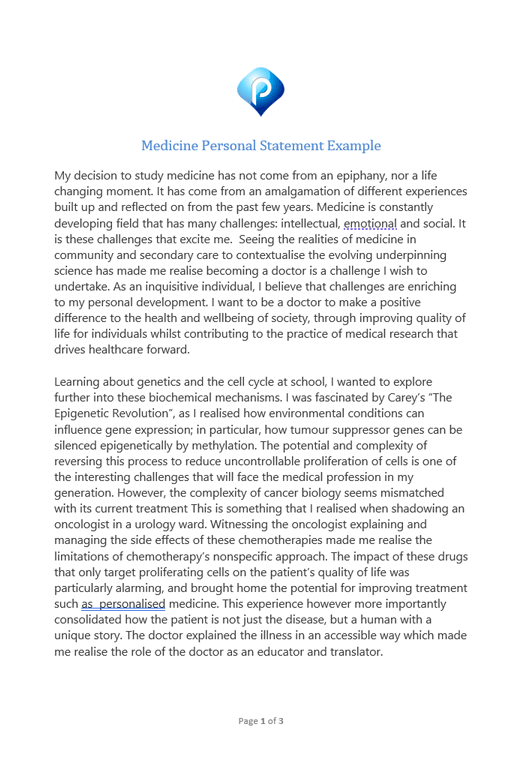
My decision to study medicine has not come from an epiphany, nor a life changing moment. It has come from an amalgamation of different experiences built up and reflected on from the past few years. Medicine is constantly developing field that has many challenges: intellectual, emotional and social. It is these challenges that excite me. Seeing the realities of medicine in community and secondary care to contextualise the evolving underpinning science has made me realise becoming a doctor is a challenge I wish to undertake. As an inquisitive individual, I believe that challenges are enriching to my personal development. I want to be a doctor to make a positive difference to the health and wellbeing of society, through improving quality of life for individuals whilst contributing to the practice of medical research that drives healthcare forward.
Learning about genetics and the cell cycle at school, I wanted to explore further into these biochemical mechanisms. I was fascinated by Carey’s “The Epigenetic Revolution”, as I realised how environmental conditions can influence gene expression; in particular how tumour suppressor genes can be silenced epigenetically by methylation. The potential and complexity of reversing this process to reduce uncontrollable proliferation of cells is one of the interesting challenges that will face the medical profession in my generation. However, our the complexity of cancer biology seems mismatched with its current treatment This is something that I realised when shadowing an oncologist in a urology ward. Witnessing the oncologist explaining and managing the side effects of these chemotherapies made me realise the limitations of chemotherapy’s nonspecific approach.. The impact of these drugs that only target proliferating cells on the patient’s quality of life was particularly alarming , and brought home the potential for improving treatment such as personalised medicine. This experience however more importantly consolidated how the patient is not just the disease, but a human with a unique story. The doctor explained the illness in an accessible way which made me realise the role of the doctor as an educator and translator.
Volunteering as a meal time assistant in a gastroenterology ward for three months, I gave patients breakfast, which at times proved challenging. One patient who was nil-by-mouth was confused and frustrated about his meal plan. Talking to him required empathy and sensitivity. I realised how crucial communication skills are in a clinical environment. Working alongside the nurses, I emulated their friendliness, approachability and calm demeanour. As every patient was different, I developed my adaptability, listening skills and confidence. By understanding the patient behind the disease, I noticed hidden issues more easily. After speaking to an elderly patient, she told me she felt drained and suicidal. I learned the importance of the holistic approach, considering loneliness is common in hospitals. This made me more understanding, caring and emotionally resilient. I started to reflect on Atul Gawande’s “Being Mortal” where the role of a doctor is not solely to ensure survival, but to enable wellbeing. I further appreciated this as a volunteer at a care home for physically disabled adults. Engaging with them and participating in activities, such as ‘wheelchair dancing’uplifted their mood. I appreciated how I made a small but meaningful difference to their day.
Observing bronchoscopy, I was impressed at how the doctor systematically collaborated with both the patient and the nurses to ensure the right dose of anaesthetic was given. It emphasised the effectiveness of teamwork which I applied when volunteering at my local pharmacy, allowing me to develop strong working relationships. Working at a fast pace and interacting with patients on the front desk enabled me to work practically under pressure, enhancing my professionalism and interpersonal skills. Picking out correct medications for prescriptions gave me insight into how common lifestyle diseases are a growing issue in modern medicine. This influenced me to undertake an EPQ on the extent in which obesity influences diabetes mellitus.
I have undertaken research and written a dissertation as part of Brilliant Club Scholar programme on assessing the safety of nuclear fusion as an energy source. This demanded academic rigour, critical thinking and evaluation, enabling me to achieve a First-Class Honours with distinction.
In my spare time, I enjoy playing the clarinet, where I am currently working towards grade 8. I feel that it is my creative outlet and personally enriching. Playing hockey in a team provides a sense of belonging and identity. I also enjoy reading fiction as a tool of relaxation.
2018-8-24-1535147901
Why this example works — strengths and ways to improve
This medicine statement offers genuine clinical exposure and two well-chosen readings, and the oncology passage connects science to patient experience thoughtfully. However, later paragraphs drift into skill lists, several reflections are asserted rather than explored, and careless errors undermine precision. The EPQ and Brilliant Club work deserve explanation of what you actually found, not just outcomes.
Subject motivation
Medicine is constantly developing field that has many challenges: intellectual, emotional and social.
Rejecting an epiphany narrative is honest, but the opening relies on abstract claims about challenge and enrichment. Your real motivation emerges more convincingly later, through the oncology and ward experiences. Consider letting those concrete moments carry your reasons rather than general statements about being inquisitive.
Academic preparation
how tumour suppressor genes can be silenced epigenetically by methylation
This is the strongest academic moment: a specific mechanism linked to Carey's book and then tested against clinical reality. By contrast, the EPQ on obesity and diabetes is only named. Stating your question, method or conclusion would show the independent thinking it represents.
Evidence and reflection
made me realise the limitations of chemotherapy’s nonspecific approach
The oncology reflection genuinely connects observation, science and patient impact. Elsewhere, reflection becomes formulaic, as in claims that you developed adaptability, listening skills and confidence. The disclosure of a suicidal patient is significant but passes quickly; explaining how you responded appropriately would matter more than the stated outcome of resilience.
Relevant experience
One patient who was nil-by-mouth was confused and frustrated about his meal plan.
Meal-time assisting, care home volunteering and pharmacy work are excellent ordinary evidence, and this example is concrete. Describing what you said or did with him would show empathy rather than assert it. The pharmacy-to-EPQ link is a good, logical progression.
Credibility and voice
enabling me to achieve a First-Class Honours with distinction
The Brilliant Club placement is credible, but the nuclear fusion topic is not linked to medicine, and the grade replaces discussion of what you learned. Phrases such as enhancing my professionalism sound generic. Your voice is strongest when describing specific observations, such as the bronchoscopy teamwork.
Structure and format
However, our the complexity of cancer biology seems mismatched with its current treatment
The overall sequence of science, clinical exposure, volunteering, research and interests is sensible. However, errors like this sentence, a missing article in the opening, a double full stop and stray spacing suggest insufficient proofreading. The closing hobbies paragraph ends abruptly without drawing the statement together.
What you’ve done well
- The epigenetics reading is connected to observed chemotherapy side effects, showing you can relate science to patient quality of life.
- A varied range of accessible experiences, including meal-time assisting and pharmacy work, gives breadth of insight into care settings.
How this draft could improve
- Replace skill lists, such as adaptability, listening skills and confidence, with one detail of what you actually did and learned in each setting.
- Explain the EPQ's findings and what the Brilliant Club dissertation taught you about evaluating evidence, rather than only naming outcomes.
- Proofread carefully for grammar and punctuation, and add a brief conclusion that ties your experiences back to why you want to study medicine.
Related personal statements
- Mental Health Nursing BSc personal statement example
- Sports and Exercise Science BSc
- Sport Science BSc (Hons) personal statement
- Emergency Medicine personal statement example (10)
- Medicine (Undergraduate) Personal Statement Example (8)
- Physiatry (Residency Program) Personal Statement Example
- Veterinary School Personal Statement Example
- Nursing Science and Healthcare Leadership MSc personal statement example
- Occupational therapy personal statement example
- Medicine example personal statement (7)