- Reading time: 4 minutes
- Price: Free download
- Published: 24th March 2024
- Word count: 992 words
- File format: Text
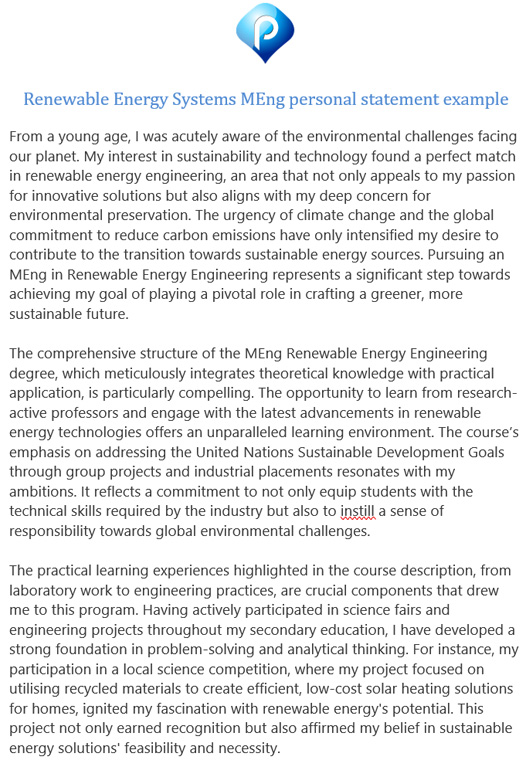
From a young age, I was acutely aware of the environmental challenges facing our planet. My interest in sustainability and technology found a perfect match in renewable energy engineering, an area that not only appeals to my passion for innovative solutions but also aligns with my deep concern for environmental preservation. The urgency of climate change and the global commitment to reduce carbon emissions have only intensified my desire to contribute to the transition towards sustainable energy sources. Pursuing an MEng in Renewable Energy Engineering represents a significant step towards achieving my goal of playing a pivotal role in crafting a greener, more sustainable future.
The comprehensive structure of the MEng Renewable Energy Engineering degree, which meticulously integrates theoretical knowledge with practical application, is particularly compelling. The opportunity to learn from research-active professors and engage with the latest advancements in renewable energy technologies offers an unparalleled learning environment. The course’s emphasis on addressing the United Nations Sustainable Development Goals through group projects and industrial placements resonates with my ambitions. It reflects a commitment to not only equip students with the technical skills required by the industry but also to instill a sense of responsibility towards global environmental challenges.
The practical learning experiences highlighted in the course description, from laboratory work to engineering practices, are crucial components that drew me to this program. Having actively participated in science fairs and engineering projects throughout my secondary education, I have developed a strong foundation in problem-solving and analytical thinking. For instance, my participation in a local science competition, where my project focused on utilising recycled materials to create efficient, low-cost solar heating solutions for homes, ignited my fascination with renewable energy’s potential. This project not only earned recognition but also affirmed my belief in sustainable energy solutions’ feasibility and necessity.
Delving deeper into my preparatory journey, the curriculum’s meticulously structured progression from foundational to specialised topics aligns seamlessly with my prior educational and extracurricular efforts. Within the realm of mechanical and electrical engineering, my engagement expanded beyond conventional classroom boundaries, as I actively sought out supplementary learning opportunities to enhance my understanding and skills. Particularly noteworthy was my leadership of a project in a robotics club, where we endeavoured to create a solar-powered robotic arm. This initiative not only honed my skills in mechanical design and electrical circuitry but also cultivated an appreciation for the potential of renewable energy sources in automation and technology.
Additionally, my participation in coding clubs introduced me to the complexities of programming and its pivotal role in optimising energy systems. Through developing algorithms intended to maximise the efficiency of solar panels based on sunlight exposure, I gained practical insights into how software integration is fundamental in advancing renewable energy technologies. This experience underscored the significance of interdisciplinary knowledge in tackling the multifaceted challenges of renewable energy engineering.
The relevance of these experiences to the MEng Renewable Energy Engineering course cannot be overstated. The foundational knowledge in engineering principles acquired through my involvement in these projects provides a solid groundwork upon which the course’s advanced topics, such as energy storage, smart grids, and low emission vehicles, can build. The project-based approach of the robotics and coding clubs mirrors the hands-on, problem-solving ethos of the MEng programme, embodying the integrative nature of engineering solutions required in the renewable energy sector. For instance, the depth of understanding I developed around energy storage systems through my extracurricular projects aligns directly with the course’s emphasis on advanced technologies in wind, solar, and geothermal energy.
This synthesis of theoretical learning with practical application is crucial in navigating the complexities of renewable energy systems. My exploration of smart grids through coding simulations enabled me to appreciate the intricacies of energy distribution and management in a renewable-powered world. This insight is particularly pertinent to my aspirations within the programme and the renewable energy industry, as it emphasises the critical role of innovative engineering solutions in achieving sustainable energy goals.
These collective experiences have not only fueled my enthusiasm for renewable energy but have also equipped me with a unique set of skills and knowledge that positions me to excel in the MEng Renewable Energy Engineering course. My background in mechanical and electrical engineering, enhanced by my leadership in extracurricular projects within robotics and coding clubs, has instilled in me a passion for innovation and a commitment to advancing renewable energy technologies. It has prepared me for the rigorous academic journey ahead, ensuring that I bring a comprehensive understanding and practical perspective to the challenges and opportunities presented in the renewable energy sector.
The final years of the course, focusing on cutting-edge technologies like wind, solar, geothermal energy, hydrogen, and carbon capture, are particularly intriguing. The opportunity to engage in a substantial year-long research project in these areas is something I eagerly anticipate. I envision delving into projects that explore innovative energy storage solutions or the integration of renewable energy sources into existing grids, contributing to overcoming some of the most pressing challenges in renewable energy deployment.
My vision extends beyond academic achievements. Through voluntary work with local environmental groups and involvement in initiatives aimed at increasing public awareness of renewable energy benefits, I have cultivated strong leadership and communication skills. These experiences have also highlighted the importance of community engagement in driving the transition to renewable energy, an element that I am keen to explore further through the industrial engagement opportunities offered by the program.
In conclusion, my passion for renewable energy, backed by a solid foundation in science and engineering, makes me confident in my ability to excel in the MEng Renewable Energy Engineering course. My ambition to contribute to sustainable energy solutions, coupled with the program’s emphasis on innovation, practical skill development, and addressing global challenges, aligns perfectly with my career aspirations. I am eager to immerse myself in this program, confident that it will equip me with the knowledge, skills, and experience necessary to make a significant impact in the renewable energy sector.
Why this example works — strengths and ways to improve
You have promising raw material: a recycled-material solar heating project, a solar-powered robotic arm and solar-panel algorithms. However, these are summarised rather than examined, while much of the length repeats course-brochure language and claims of fit. The statement reads as an undergraduate MEng application; it would gain credibility with fewer abstractions and more technical detail about what you built, tested and learned.
Subject motivation
From a young age, I was acutely aware of the environmental challenges facing our planet.
This opening states concern but does not show what sparked it. Your solar heating project later supplies a genuine origin story. Leading with that concrete moment, rather than climate urgency in general, would make your motivation distinctive and believable instead of widely shared.
Academic preparation
My background in mechanical and electrical engineering
You never name the subjects you studied, the topics that challenged you or the mathematics and physics you have used. For a secondary-stage applicant, this phrase also overstates your training. Grounding preparation in specific coursework or self-study, such as circuit analysis or thermodynamics, would be more convincing.
Evidence and reflection
utilising recycled materials to create efficient, low-cost solar heating solutions for homes
This is your best evidence, but you do not reflect on it. What materials did you use, and how did you measure efficiency? What failed and what did you change? Reflection on design trade-offs would demonstrate engineering thinking far better than saying the project affirmed your belief.
Relevant experience
developing algorithms intended to maximise the efficiency of solar panels based on sunlight exposure
This experience is relevant, but you leave its method vague. Explain what inputs the algorithm used, whether you tested it on hardware or in simulation, and what you found. Your volunteering paragraph is similarly unspecific about activities, audiences and outcomes.
Credibility and voice
The relevance of these experiences to the MEng Renewable Energy Engineering course cannot be overstated.
Assertions like this, along with phrases such as unparalleled learning environment and positions me to excel, replace evidence with emphasis. Claimed depth in energy storage and smart grids is never shown. Plainer, specific statements would give your voice more authority.
Structure and format
Delving deeper into my preparatory journey, the curriculum's meticulously structured progression
Several paragraphs repeat the same move: your experience aligns with the course. Praise of the course appears in at least four places, and the conclusion restates earlier claims. Grouping course fit into one focused paragraph would free space for technical detail.
What you’ve done well
- You have three related, hands-on projects (solar heating, a solar-powered robotic arm and solar optimisation code) that together show sustained interest across mechanical, electrical and software areas.
- You identify concrete future interests, namely energy storage and grid integration, that connect logically to the year-long research project you mention.
How this draft could improve
- Choose one or two projects and explain the method, a problem you encountered, how you solved it and the specific technical lesson, replacing generic skill claims such as honed my skills.
- Cut the repeated course-alignment passages, especially the paragraphs beginning The relevance and This synthesis, and use one concise paragraph to say which named modules or features matter to you and why.
- Specify your role and results in the robotics leadership and the environmental volunteering, and check that the claimed knowledge of energy storage and smart grids is supported by work you actually describe.
Related personal statements
- Jewellery and objects BA (Hons) personal statement example
- Urban Planning BSc (Hons) Personal Statement Example
- Aerospace Engineering BEng Personal Statement Example
- Architectural degree personal statement (6)
- Aeronautical / Astronautical Engineering Personal Statement
- Civil engineering personal statement example
- Mechanical Engineer Personal Statement Example Personal Statement
- Engineering Personal Statement Examples
- Engineering degree personal statement example
- Construction Management Masters personal statement