- Reading time: 2 minutes
- Price: Free download
- Published: 21st August 2019
- Word count: 600 words
- File format: Text
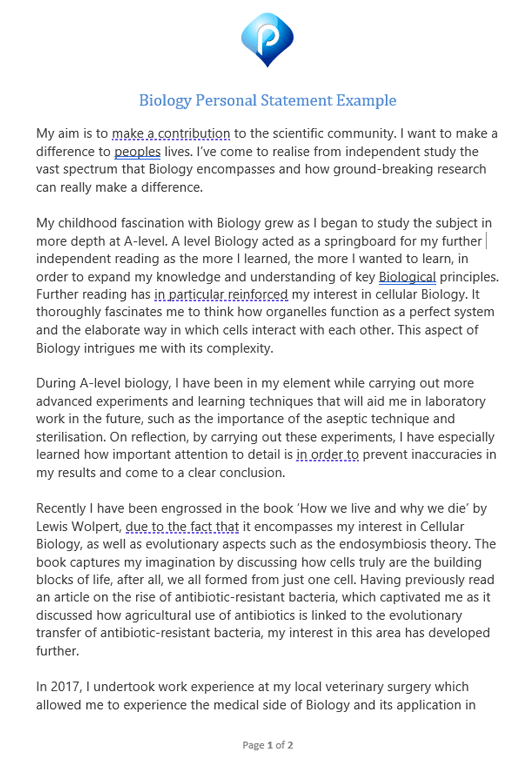
My aim is to make a contribution to the scientific community. I want to make a difference to peoples lives. I’ve come to realise from independent study the vast spectrum that Biology encompasses and how ground-breaking research can really make a difference.
My childhood fascination with Biology grew as I began to study the subject in more depth at A-level. A level Biology acted as a springboard for my further independent reading as the more I learned, the more I wanted to learn, in order to expand my knowledge and understanding of key Biological principles. Further reading has in particular reinforced my interest in cellular Biology. It thoroughly fascinates me to think how organelles function as a perfect system and the elaborate way in which cells interact with each other. This aspect of Biology intrigues me with its complexity.
During A-level biology, I have been in my element while carrying out more advanced experiments and learning techniques that will aid me in laboratory work in the future, such as the importance of the aseptic technique and sterilisation. On reflection, by carrying out these experiments, I have especially learned how important attention to detail is in order to prevent inaccuracies in my results and come to a clear conclusion.
Recently I have been engrossed in the book ‘How we live and why we die’ by Lewis Wolpert, due to the fact that it encompasses my interest in Cellular Biology, as well as evolutionary aspects such as the endosymbiosis theory. The book captures my imagination by discussing how cells truly are the building blocks of life, after all, we all formed from just one cell. Having previously read an article on the rise of antibiotic-resistant bacteria, which captivated me as it discussed how agricultural use of antibiotics is linked to the evolutionary transfer of antibiotic-resistant bacteria, my interest in this area has developed further.
In 2017, I undertook work experience at my local veterinary surgery which allowed me to experience the medical side of Biology and its application in real life situations. This experience especially expanded my knowledge of anatomy as I had the privilege of observing numerous x-rays, operations as well as dissection. These invaluable experiences have taught me a wide range of skills, such as sterilising equipment in an autoclave, that will prove beneficial to me in a future Biological career.
Work experience reinforced my aspiration for a career in Biology. As a result of this, I began a job at my local café to save money for a volunteer trip to Sri Lanka earlier this year. This experience taught me the importance of hard work and independence, qualities that will prove valuable to me in university. This once-in-a-lifetime trip encompassed turtle conservation, which expanded my knowledge of plastics in the ocean and ocean acidification, issues that have recently come to light within the scientific community. The second part of my trip consisted of teaching biology to students at the local tsunami school, which proved to be incredibly rewarding as I got the opportunity to pass on my passion and knowledge of key Biological concepts.
Making a difference is at the forefront of my aims for the future, and I want to inspire others with my passion for Biology, through teaching or research. I thoroughly enjoyed the teaching experience in Sri Lanka, seeing student’s enthusiasm for the subject was a particular highlight of my experience. The idea of conducting research in the field of oncology and Cell Biology and bringing my aims to fruition is exciting, as I yearn to learn more about the complexity of our ever-changing world.
Why this example works — strengths and ways to improve
Your statement shows genuine enthusiasm for cell biology and offers useful evidence: Wolpert's book, aseptic technique, vet work experience and teaching in Sri Lanka. However, much of it describes interest rather than demonstrating thinking. Feelings like fascination and captivation recur, while specific ideas, questions or conclusions you drew are rarely explained. Deeper reflection on fewer examples would make it more persuasive.
Subject motivation
It thoroughly fascinates me to think how organelles function as a perfect system
Your focus on cellular biology gives your motivation a direction, but you assert fascination rather than showing what specifically caught your curiosity. Naming a particular process, puzzle or question about cell interaction would turn this into a recognisable intellectual interest rather than a general statement of enthusiasm.
Academic preparation
the importance of the aseptic technique and sterilisation
Mentioning aseptic technique is concrete and relevant to undergraduate lab work. You could strengthen it by naming the experiment, describing what went wrong or right, and explaining how attention to detail changed a result. At present the learning point about accuracy is sound but stays general.
Evidence and reflection
evolutionary aspects such as the endosymbiosis theory
Citing Wolpert and endosymbiosis is promising, but you summarise rather than respond. What did you find convincing or surprising? Similarly, the antibiotic-resistance article is described as captivating without stating any idea you took from it. One sentence of your own reasoning per source would add real depth.
Relevant experience
sterilising equipment in an autoclave
The veterinary placement and Sri Lanka teaching are useful, and the autoclave detail is specific. The café job, saving for the trip, is good ordinary evidence of commitment. Yet observing x-rays and operations, turtle conservation and teaching each lack a particular moment or insight showing what you actually learned.
Credibility and voice
My aim is to make a contribution to the scientific community.
Your opening and closing rely on broad aims such as making a difference, which many applicants share and which dilute your voice. Repeated intensifiers like engrossed, captivated and in my element create enthusiasm but feel formulaic. Specific observations would sound more like you and be more credible.
Structure and format
Making a difference is at the forefront of my aims for the future
The sequence from school study to reading to experience to future aims is logical. The ending returns to making a difference and adds oncology without prior grounding, which feels abrupt. Small errors such as peoples and student's, and inconsistent capitalisation of Biology, need proofreading.
What you’ve done well
- You give concrete practical details, such as aseptic technique and autoclave sterilisation, that show familiarity with real lab practice.
- Your reading links cell biology to evolution through endosymbiosis, suggesting an interest that connects topics rather than staying isolated.
How this draft could improve
- For each book, article or experience, add one sentence stating a specific idea you took from it or a question it raised.
- Replace generic aims like making a difference with a concrete scientific question you want to explore, and introduce oncology earlier if it matters to you.
- Cut repeated emotional intensifiers and proofread apostrophes and capitalisation of Biology for consistency.
Related personal statements
- Environmental Geography (BSc) personal statement example
- Chemistry BSc (Hons) Personal Statement Example
- Physics BSc (Hons) Personal Statement
- Zoology BSc Personal Statement Example
- Forensic Science BSc (Hons) Personal Statement
- Environmental Science BSc personal statement example
- Chemical Engineering BSc Personal Statement Example
- Biotechnology BSc Personal Statement Example
- Biochemistry personal statement example
- Biomedical engineering program personal statement example